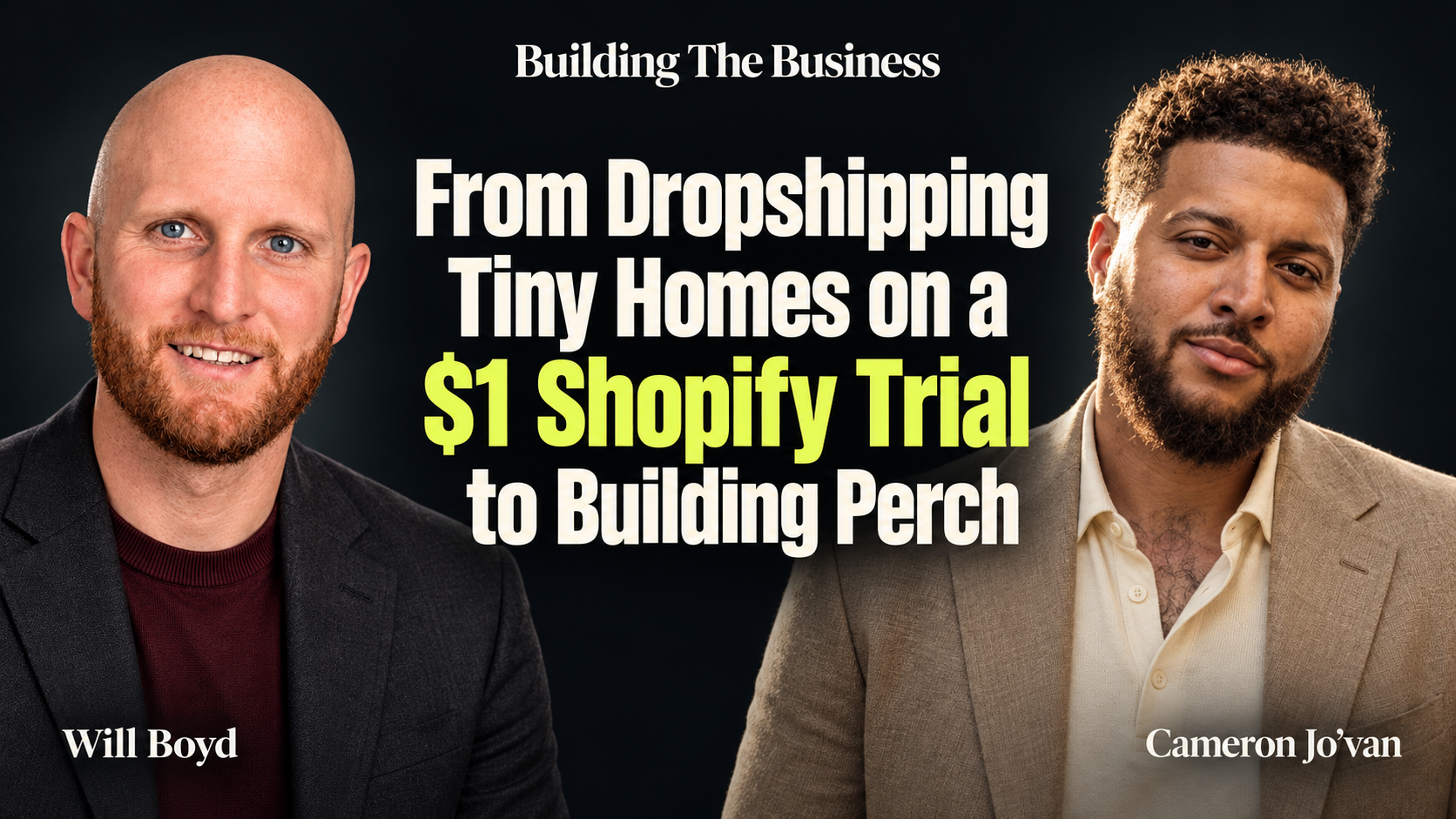
Part 2 - Rebuilding American Housing: Perch, Printify-for-Homes & the Factory-First Model
Cameron Jo'van on the Marketplace Pivot, 14 Factory Partners, $10M+ in Pipeline, and Why Builders Just Want to Build
In part two with Cameron Jo'van, we dig into Perch, the 'Printify for homes' model connecting buyers to 14 modular home factories across 40+ states, why builders just want to build, and how SEO + a single LinkedIn channel drove $10M+ in organic pipeline.
Episode Overview
In part two of our conversation with Cameron Jo'van, founder of Perch (ownperch.com), we get into the rebuild. After the tariff collapse of My Tiny Home Hub, Cameron pivoted from drop-shipping imported homes to a marketplace model, 'Printify for homes', that routes every order to the nearest US modular factory. He breaks down why the marketplace model almost failed (shipping a home cross-country costs another home's worth of fuel), why builders don't want to market or sell, and how Perch now partners with 14 factories across 40+ states. We cover the $150K-to-$700K builder markup problem, $10M+ in organic pipeline driven by SEO and a single LinkedIn channel, and Cameron's philosophy of 'Search Experience Optimization' (SXO). This is the playbook for anyone building a two-sided marketplace in a fragmented, old-school industry.
Key Lessons & Founder Playbooks
- Perch is 'Printify for homes': order online, build at the nearest US modular factory, deliver locally.
- The first marketplace model failed because shipping a home cross-country costs another home's worth of fuel and permitting.
- Builders don't want to brand, market, or sell. They want to build. Forcing it on them just raises home prices.
- Perch partners with 14 factory owners across 40+ states instead of raising capital to build its own factory.
- Over $10M in pipeline came organically from SEO and a single LinkedIn channel, with no paid ads.
- SXO (Search Experience Optimization) optimizes the full journey from first thought to feeling good about the purchase.
- The US poured ~$2.76B into prefab startups that tried to own too much of the value chain before adding value.
Full Episode Transcript
117 turns · Search keywords or filter by speaker
All right, this is part two with Cameron Jovan. Man, I'm I I'm super excited. We connected earlier in the week. If you end up watching the video version of this, welcome back. I'm so excited. We left off. So, Cameron, where we left off in the last episode, I was doing my research, re-relistening to our episode, and we had made it through your entire journey of getting up to your your marketplace home, tiny home kind of business. And it's starting to take off. And then boom, tariffs hit. And we've got an increase of tariffs, becomes unsustainable. You're having to essentially cover for a ton of of outstanding sort of yeah, costs on these homes. You're having to sort of do what's right for customers. And so I'm super excited to get in. That's that sort of has led you into perch, which is your current your current business and your current company.
Yeah.
And my my first thing, I'm just super curious. for anyone who maybe is just jumping in for the first time, maybe they skipped part one, just real quick, can you do can you just do a quick breakdown of what perch is and what you guys do and who you help?
Yeah, absolutely, for sure. happy to be on part two. Definitely feel like we're saving the best for last year. This is the part that people are probably most interested in. If they heard part one, most interested in, if they've been following along the journey or heard from a friend or from a friend or something like that. So so I'm just grateful for all the ears that are here right now. So thank you. So here's what perch is. Perch is basically I'm gonna say this like as simply as possible, as few words as possible. For the tech people out there, and then I'll say it for the non-tech people. So for the tech people, purchase printify for homes. and for the non-tech people, if you've ever done like a print-on-demand, you know, company and you wanted your company logo on a t-shirt and you like order that online, right? Nine times out of ten, that company did not. own a printing press or print it themselves. What they did is they sent it to the local printer. usually within, you know, 10, 20 miles of you, you know, within a 15 minute drive, they fulfilled the order and shipped it to you from that or just dropped it off at your door, right? and so the perch business model is such that there's already really great modular home factory owners out there. sometimes these are second, third, fourth generation family owned businesses. these are people that have figured it out from the ground up even more recently than generations ago and having, you know, good success. these are people that really are passionate about home building. and so there was no reason in my mind where I should had Have the aspiration or the ambition to go, you know, raise an egregious amount of money and open up my own factory, negating all the hard work that all these men and women have already done, right? What we need to do is say, hey, let's put a system in place that
consolidates supply and designs and these things, not in a way where we strip choice from the, you know, prospective homeowner or the developer or the or the site builder, you know, that wants to go into modular and do something a little bit differently. but to make home easy, to to to give people home that's made for their land, to to make it a more streamlined process. Right now everything's so fragmented and disconnected. and so you know, I want to make it as easy as buying a car online and as trustworthy and transparent as, you know, staring at a Domino's pizza tracker, and just seeing where your build is in the process. so you can have some peace of mind that. you know, your investment is safe and that it's at the right stage and if you need to call, you know who to call and when to call and what to call about, right? because I feel like for the average homeowner, what's happening with their home is usually veiled or behind some wall garden of, you know, phone calls or or whatever and it should be transparent, it should be easily accessible. And it should just be like quick, right? So we but we get everything else online these days, and just like home isn't one of them, and it should be.
So historic 'cause you're right, historically actually we were talking about this funny historically you could actually buy at times. Like we're talking about Sears catalogs, there was times where there were essentially we were joking like Lego style homes where they would ship it out to you and really interesting stuff. And so it's kinda cool to see how far back the like sort of modular idea of home building goes back actually. It it feels like such a modern thing, but but there is
Yeah. Yeah, right.
you know, evidence of the past of of people doing this. But I I guess I'm super curious with this camera. So just just as like obviously if you're listening to this, go check out Perch, go check out Perch's website, play around, see what you can, you know, you'll visually get a better understanding of this. But Cameron, my my sort of view of when I was doing it is and I a couple questions with this. But first is like, cool, I can see the different home options that I could buy. They're pricing listed out on that. So it's very like E com style in the sense I was like, cool. I can see what I'd be getting. I can I can get a good idea of this. and then it breaks down of like, hey, we have certain markets that that we serve. So one, it's it's very like visual as if you're gonna go buy anything else product wise. I thought that was really cool. It gives you an idea of that. Two, I'm really curious, like when we going back to when you you had your first version of this, you know, you're getting the materials from China.
Mm-hmm.
Or they're building it in China, putting it on a boat, coming over, you'd have to get transportation and pre-tariffs. That that was a you know an actually financially feasible model. But then that happens, and now you got to think because you you would deliver those to anywhere in the country, right? We talked about the rocket scientist guy in in Nevada. we talked about you know people in different areas, but this time you're going at at at individual markets. So I'm really curious.
About yeah.
When you're going put us back in your brain of like when you were doing this coming up with perch, talk me through what were kind of the variables that had to change or you know that that made it what it is now in the sense of you're you're in specific markets versus hey, we'll go anywhere. Was that due to the where existing factories were, where you could build relationships? Really curious, just open-ended here, but like what how did you have to rethink what you were doing? given the new circumstances that had come about.
yeah, this is the fun part. Okay, cool. So So yeah, like quick recap went from you know, this prior model where I was the guy selling the thing and I was it was my thing and it was my thing a few different ways, but that was it, right? And then I ideated that hey, we can do a marketplace model, you know, and this is where I moved into Perch, the Perch brand, and I said we can do a marketplace model. But what I realized about the marketplace model where it was flawed is like if you live in Pittsburgh and then you've got a home that That you like, that you found you came to the website, you found a home that you like, but let's say the home was in, you know, Florida, it was being built out of Florida. Well, the transportation cost to get, you know, a decent sized home, regardless of the, you know, the type, modular, prefab, manufactured, whichever, is gonna cost a whole nother home's worth of you know, fuel and permitting and licensing and transportation cost, you know, labor and everything to get it to you. So I said, then I'm gonna find myself in the business of telling people no, right? More or less, the experience is gonna hit a brick wall for a lot of people, most people at some point. And so I realized, even though I was really happy about it for a little bit, I realized that wasn't the model to do. And so I had to divorce myself from that model pretty quickly and kind of went through a little slumber over a weekend where, you know, entrepreneurs tend to get attached to their their their their baby for a little bit.
And you know, I had I had my my my Mr. Wonderful shark tank model, I mean moment where I was just like just take it out the back and and kill it, you know. Not to put that in the same paragraph as baby because I would never do that, but but but I had I had to just be like, Okay, that's not it. And so I released it and I had peace about it 'cause I said, Well, I know there's a way, it'll come to me. Let me like quit freaking out because I still felt called to serve the people in this space, not for not because I'm earning any money, you know, from someone expecting me to do anything, not because I raise capital and there's pressure, not because of anything other than I feel called to serve in this space, right? and so I released that and then it hit me like a freight train. I was like, okay, this is it, right? And I wasn't sure if that was it, but I felt really convicted that it was it. And so what the conviction was about was, you know what, there's already factories, as I've been learning around the US, modular home factories, most prominently. South and we've got today now, we've got, you know, 12, 13, 14 partners now, factory partners. South Carolina, North Carolina, Philadelphia, Southern California, Utah, Texas, Colorado, Indiana, some states I'm leaving out, you know, Oklahoma City. I mean, I could you know, we've got at this juncture, I think we've got a good, you know, forty, forty two states of coverage, right? And so from given everyone's you know delivery radius. But let me back up. I realized there's already good businesses here, but why don't people know?
That you can there are so many layers to this. No, like one, no one knows that they can build a home in a factory that's not as regul, you know, regular people, consumers, non-industry, technical business people, you know. you're talking about prefab pieces of crap, or you're talking about, you know, trailer homes or whatever, right? And there's like this negative connotation on those spaces. And
Yeah, yeah, yeah. Yeah.
And I understand some of the reasons, you know, a lot of those are mass produced and you know it's it's a numbers game sometimes and they're not, you know, or they see, you know, an old dilapidated, you know, mobile home park and they just get the wrong image, or they see, you know, poor Chinese product and they think that that's what all prefab is, or you know, everyone just kind of gets this image and they stick with it. And so, you know, I can't blame but That's not what modular housing is. Modular housing is climate controlled, quality controlled, you know, inspected, built for the actual state and local municipality code where it's going to, right? And that made it really powerful because that's where I said, okay, this is home made for your land, right? It can be quicker done. Now these are just like the the res the CVS receipt of benefits. You know, it's it's quicker, it's climate controlled, it's more cost effective, you know, economical overall from beginning to end. And there's just like less variables because it's not raining and storming and your your your framing's getting wet, you know, all this stuff, right? You know, your crew disappeared. You don't have to worry about these things.
Yeah, yeah, yeah, okay. Yeah.
But wouldn't it be nice if more people knew you didn't have to worry about those things? And so, like, no one knows. So I said, okay, that's major. But see, a lot of these manufacturers only build for builders. They only build for developers. They're not really doing, they're not doing consumer-level stuff. And I said, that's the disconnect.
Yeah, to go.
Because the builder, and I'm just gonna I'm everyone's gonna hate me after they hear this. The builder's getting your home for a hundred and fifty K and they're selling it to you for seven hundred thousand. Right. And so we're not talking about we're not talking
You mean you mean like getting the the parts and labor for and then the mark cut? Yeah.
They're getting the home itself delivered on a truck and you know, one to two to three to four piece, it just depends on the size of the home, the the design, the you know, the footprint. They're getting it delivered to the to the land on a truck, and it's a and it's assembled together, you know, pieced together, like Lego together, if you wanna use that as a visual. We've all played with Legos at a point. And they Lego the thing together and You know, they yes, they have a crew of, you know, good good folks that are handling the foundation and everything else on site, you know, your general contractors or or and crew. But the markup is insane, right? And I understand everyone's gotta make money. In some instances, people have to, you know, deliver shareholder value. And if you're listening, shareholder value is again in finger quotes. And I understand to a degree, but we can't look at the crisis that's happening and then turn a blind eye or do the shoulder shrug and be like, yeah, I don't know what's going on. You know what's going on. You didn't need to make five hundred thousand dollars of you know revenue on that house. All right, you didn't have to. You would have been okay with 200 or 300 or whatever, right? Or or or you know, especially when you're doing scale, right? And so
Yeah. Yeah, yeah, yeah.
but you know, you gotta We've got this society where we have to keep up appearances, right? So, you know, God forbid the the seemingly luxury home cost actually a lot less than what we think it's, you know, cost, right? And so, that's that's one facet of the problem, right? There's an awareness problem, there's or or a challenge. I want to call it a problem. There's an awareness challenge, there's A fragmented supply challenge, right? And so all that creates a gap and a divide and a disconnect from the consumer who's like, I almost don't care how you do it, I just want a good quality home. I don't want anybody to run. And I just want peace of mind about the situation and I just want to be happy. And unfortunately, there's been so many inventions and innovations and all these other kind of things in the space that just create more divide from that outcome or have to spend two billion dollars before you can get to that outcome. You know? it's just it's I don't know, man. It's it's sad. I I've been ranting a little bit on this, but it's just it's just sad how
Yeah. Yeah.
No. I'm I'm
You know, there's there's somebody that wants one thing here and the there's a desire and the outcome is here. And the outcome is not multi-dimensional or multi-layered. It's just one thing. I just want a home. And I want to be able to afford the home. And when I have the home that I could afford up front, I also want to be able to afford to maintain the home once I have it. Right. So those are the that's just the one thing. And then down here in reality, there's like 20 layers to get to that thing and all these conversations and policy and it's gotta be bipartisan and like you know, and you you're not earning enough and like what are we talking about? It's like what's actually happening, right? What is going on? It it's it's really not that complicated. I have no intentions, Perch has no intentions of selling homes for, you know.
Yeah. Yeah. Yeah.
six hundred thousand dollars and seven like that's there's plenty of those there's plenty of
just on the site. It's I mean I I think I saw that you know it looked like it was anywhere from I you could correct me, but it looked like anywhere from like sixty to maybe a hundred sixty K was kind of the average range I was seeing of like home on their
Yeah, there's there there's one one fifty K and then we're doing some on a on a on a we're working to get some models on a smaller scale. I think one twenty nine is the lowest right now, but we're working on some other some other options. and you know, yeah, you have to have land. we're not gonna be in the business of procuring land. There's people with land, it's not too challenging to find it. but I don't want to be the captain of someone's destiny on that on that regard. I think that I think that there's some pride in having some Yeah. It's a big decision. There's to be some ownership over some of these things. some of these decisions, but what we can do and what I want to do is just the one thing really well, which is like
Yeah. That's a big that's a big decision in its own self. Like do you want to own land? Do you wanna manage land? Yeah, that's a yeah.
helping you find a home and helping you buy it and feel good about it and trust it and then like get it delivered and then you've got your warranty and your assurances that it's gonna be delivered and be great and and then you can like move in and get your keys and you're you're set, right? And so that's it. There's there's there's I don't need to own or control or you know do anything. outside of that, there's already people that build the homes and the factories. They have the factories, and there's a heck of a lot of them. And so the model is like this: you should be able to go online, order a home wherever you are in the US, and regardless of that home design, it should get sent to the nearest factory to you. To get built and delivered from that point. And then you're able to look online on your portal and schedule your milestone, you know, or escrow payments as proof is submitted that the milestones are being hit via photo and photographic and video graphic proof of the build out, you know, and and text updates and everything like that from the builder. And then you release those payments, they continue building, you release the payment, they continue building, you release the payment, it gets trucked to you, you see who to contact then, and so on. It's just like it could really be that simple. And you and you didn't have to spend, you know, market rate on your home. so it's just I feel like we're swinging for the fences, but
Yeah. Yeah. I see
Yeah.
It's just a couple base hits. Like the dream is just a couple base hits away, man. It's a couple couple bunts, you know, a couple base runs. Like it's not we don't have to go crazy.
Yeah. Well, I think what's what's really so as you're talking, it's as as you're talking about it, it's brought up a couple things. One on the for me on the on the consumer side myself of like, hey, if I were gonna go buy one of these, obviously I'm thinking through you've brought it up so many times over the two parts, which is just consumer safety, feeling like trust and safety in the sense of not physical harm, but like safety of like Is my money gonna be taken care of? Am I gonna get the thing that I'm I'm asking for? I see where eventually over time, like customer videos of of people in their homes, you know, this is gonna be huge of just, hey, I see other people who are doing this, people out and about going, well, it's who'd build your home? it was you it's through perch, I got it ordered, be massive. I do think I got me curious too, as you're talking of like, why why hadn't this come about before? Or maybe they had tried before. I don't know. I you know, I guess some things that naturally come up are if you went the if you went the factory route yourself and you're gonna build it, everything that's a big capital investment up front. Like you're gonna have to build a warehouse, you're gonna have to invest in material, labor. and then, you know, that's where the offshore model made sense in a lot of ways, which just blows my mind of how cost effective that must have been if we could still afford all the logistics of shipping all over the US to do that. And then
Yeah.
Mm-hmm.
Now that that's kind of off the table, or at least much more difficult, like what's what what do you feel like has kept these guys like for example I guess I'm just curious, like why don't the manufacturer guys go like create their own brands and and and do that? Is it just maybe they don't really know the marketing game isn't their thing of getting out there? So I just kind curious, like, have any of them tried that and it just doesn't that's just not their jam? And like that's where creating a marketplace just makes a ton of sense.
Yeah.
Just curious 'cause sure you've thought through all this kind of stuff, yeah.
Yeah. For sure. I mean it's it's are there builders or are there factory owners who are builders at art, right? There's the so you've got two kinds of builders. You've got on site builders, which are stick building as we call it, and they're building on the land, you know, from the dirt right there. in in real life, right? And then you've got off site builders, which are building in, you know, basically giant warehouses that have, you know, crew and and supplies and materials and robotic arms and what stuff like that, right? and so your off site builders are still builders nonetheless. Okay. all of them are licensed the same, if not more on the off site side. And you know So they're just as qualified as the onsite guys just for for setting the baseline. you gotta understand human nature, really, in this and understand that. Builders want to build. They don't want to do anything else. Because if I have to, as the builder, as the owner, as the face of this company, if I go create a brand and now I've got to do what? Raise the price of the home to compensate for all this, you know, ad spend and media spend and branding and photography and this, that, and the other, just to build a little more. Just to create a little more favor, a little more goodwill, a little more brand trust, a little more like it's it's too much for them because they don't even like doing that anyway. They're not, you know, they're not a people person. They're they're I wanna build a home, right? Tools I this is my famous saying. tools don't talk. You know, I love tools 'cause they don't talk and I don't gotta talk to I just want to build the house. I wanna I wanna drill the bit, I wanna, you know, hammer the nail, I wanna
Yeah,
Yeah. Yeah.
to torque the, you know, so people there are people that love that. And I'm not I'm not being, you know, I love them. They're great people. I'm not creating any any div divisiveness or anything like that. You know, lawyers want to argue. They want to prove a point. Dentists want to work. Yeah. Yeah.
we see we see this all the time. We're, you know, we're in the fractional CFO world. We're we we're a little different that we came from business owners who got into it versus so many of our accountants and bookkeepers that they don't they don't want to market. They don't want to sell, they don't want to go present. They just they just wanna like, hey, give me the checklist. I'm gonna go, you know, I'm I'm simplifying things. So I totally makes total sense. Like personality types tend to drift towards certain you know, types of work. Yeah. Yeah.
They don't want to do it.
Right.
Exactly. We're we're all yeah. We're we're we're all gonna do what we're great at doing, what we're passionate about. And so you've already got so many people that are just passionate about building, why force anything on them that they're not trying to do? It just goes against their nature, it goes against the grain. And it would create friction in the process because they'd be either fumbling through it or just spending time, aka money, aka now I gotta raise your home price. Right. And so we don't want that. so let's just let's just not
Yeah. We'll find people like Cameron who are gonna create the demand and build a marketplace and drive demand for us. Yeah.
Let's yeah. Exactly. I'm more passionate about
Helping people I'm more passionate about I'm a builder myself. I'm not a builder in terms I build homes. I'm a builder in the sense that I build systems to help people realize their desires. Right. So if the desire is to own a home, if the desire is to you know, have transparency if the desire is to make it simple, if the d whatever the d underlying desire is, I find a way to build the system to make that a reality. And so on the on the back end, there's benefits for the builders to, you know, partner with us as well. They desire to just build more, talk less, give the updates, yes, you know, consolidate supply on their end and, you know, make building more economical. And just have community amongst other people like them, other builders, and figure out, hey, what's the best way to, you know, have the line structured and so on and so forth. There's there's all kind of conversations that need to happen in this space at a time where we're having these like macro and micro cr crises in these different markets and at scale as a country and then going into other countries that have these problems like Canada and abroad. And I mean it's it's
America we we when we say America, we just think it's the United States. America's big in the whole of America has this problem. and so
Yeah. Yeah.
Is there just one solution? No, it needs, you know, everyone, everywhere, all at once, as it said. but I feel like we don't have to create net new problems by putting strain on the capital infrastructure. of our nation, the people who have money and that are investors and everything, we don't have to put strain on them and say, hey, give me two billion, give me eight hundred million, give me three hundred million, give me we don't have to go for those. We don't have to do that. You know, you keep your money for something else. all the money that we've
Yeah, yeah, yeah.
And I say we as a nation, all the money that we've thrown out on these startups that, you know, the Katara and Tekra, Mighty Buildings, Welcome Homes, all the money that we've raised on these almost three billion dollars, 2.7625, if you want to be exact. billion dollars. Imagine how many homes that would be if you just said, hey, let's just solve the problem one-to-one. Let's just go build the homes. Right. And that's not what we did though. We said, let's invest in a system that can build the homes. And I see the idea and the aspiration and the motivation behind it, but the systems were too grand in that they just tried to own too much of the value chain before they added any value first, right? Because again, they didn't look to the it's like if I tried to give you a new limb, Will, and I said, Hey, I got a new arm for you. And you're like, Great, I've been needing that. You're like, hey, just checking, you know, is this gonna is this gonna receive signal from the my backbone, my spine? I'm like, absolutely not. Right, but you've got an arm, right? It's gonna be people can see it, right? It's big, people can see it. This this arm is jacked, and you're like, all right, but it's gonna fall off, you know, and you're gonna be without arm once again. And so that's been the US time and time again with these massive startups.
you have an arm. Yeah. Yeah. It's visible, people can see it, yeah. Yeah. Yeah.
That have raised so much money to solve for this, you know, affordable housing crisis, a housing crisis. They've they raised too much money. And it's like, listen, if there has to be hundreds of millions of dollars between you and someone getting a home, that's problematic. That's a problem by itself. Scale it back, scale it down. Let's just figure out, let's talk to the spine, let's receive signal from the spine, from the backbone. And I feel like the backbone of America, willing to argue this with anyone. I feel like the backbone of America should be and is or should be seen as the modular home factory. built housing owners across America because they have capacity that no one else has, they have skills that no one else has, they have knowledge that no one else has. And they just need a little bit of help. They just need a little bit of a layer of an infrastructure, of a system to make what they do easier, to do more of what they do to do that better. Right. And in a way that serves more people more often and in the right places. And I really feel like it's just that simple. and I don't need, and perch doesn't need, and I don't think anyone should need to any investors that might be listening. No one needs a billion dollars to do this. Okay. So don't go writing ridiculous checks. Stop it. We don't, we don't need it. Yeah. Cut it out, please.
I love Yeah, I love I love one I just love. I mean I can tell how passionate you are about the just the the housing issue overall. Like one it just really comes through and I I I really do you know, you mentioned before like it feels like you were called to this and I can feel the the energy and like the the passion behind that and I just think that's Man, it's it's just kind of rare. You meet a lot of people who are in business to make money and and it's maybe less of a purpose driven and that's okay. Like, hey, we all gotta you know, we all gotta feed ourselves. So it's cool when you meet somebody who's like, no man, like this is this is my thing. I do a lot of deep thinking about it. I am just to kind of like rap on the business side of stuff, it makes me think of
Yeah. Yeah. Right.
You go you're you know, you're you're going out to the market, purchase out there now. I'm really curious. as the market or sales kind of side of stuff in my brain is okay, now you got the the I know it's a calling, but there's also probably the financial reality of like we also have to get customers for this. What's what's kind of been your sort of process in like looking to acquire customers? Cause I imagine that's gonna be one of the bigger costs for you is gonna be your your Maybe I'm wrong on that. I just imagine we're probably gonna have to go out to the public. I know you're a a marketing ads guy. Like, are you are you thinking starting you know, has has it been more of a focus on we're gonna potentially get into paid quickly and and try to figure out how we make that sort of funnel work? Is it we're actually gonna tap into I don't even know, like homeowner association groups and stuff and try to do more referral driven side of stuff. Where where's your head been going from I know as the marketing guy you've been for so many companies in the past, like
Yeah.
for go to market. Yeah.
Yeah. Yeah, absolutely. That's a good question. so much of the success that I had in a prior venture was z SEO driven. And so SEO is just, you know, search engine optimization. and it costs you nothing but elbow grease. And you know, I mean people people are right. Yeah, you elbow grease it out, man. And
Mm. Yeah, good.
Especially pre AI when you were a man, you're literally writing all the
One thing my dad used to say when I was younger is he'd say they don't call it work because it's fun. And I was like, that's interesting. But I actually have fun doing this. So that's the challenge, you know. I'm married now, but when I was I was dating, you know, they would say, like, well make sure you go out and have some fun. And I'm like, all you do is work. And I'm like, Yeah, that's the the problem is.
Yeah.
I like what I'm doing. I love what I'm it's fun to me. So I'm when I I actually will stop work, go eat and come back and have my fun, right? Like and so my fun is is just building the solution that makes the people happy. you know, for what I'm building towards. But but to but to get back to the question, it's
Yeah, do yeah.
Right now we've got, you know, over ten and a half million in pipeline. We've got, you know, about fourteen factory partners across the US. We've got communities that want homes from our partners, you know, across Florida, Southern California, Tennessee, Texas, Northern California, And Nevada, right? And so sweet, sweet home Nevada. And and so it's great, it's great. And it all that's happened organically. And it's happened organically, and the source is just content, right? Is putting out, spreading the gospel, putting out the good word, you know, this is what this is what I'm hey, I'm Cameron, here's what I'm called to do. I'm the founder of Perch. Here's what I see wrong with the current system. Here's where I see the investments going to that I don't believe should be going there. Here's the failures and what needs to happen differently. Here's the old way. Here's the proposed new way. Here's you know, what people actually want. So say the the data and the voices, right? Here's just what I think, right? And so putting those messages out, I'm not concerned with pleasing everybody. I I'm not a a people pleaser, I'm not here to be right all the time, I'm not here to you know, d to have some like a weird agenda or anything like that. I'm just here to say I'm an observer of the problem I feel I've been called to get qualified in this space and offer some solutions that I uniquely feel could be of value and chip away at this iceberg of a problem that we've got. and it's a community effort. And if you're willing to lend your voice and your skills and you know, 30 minutes or an hour of your time or whatever along the journey.
then I'm grateful and I'm appreciative because it's going to help the whole, rather than the few or the or the sum. And I'm just appreciative and I'm gonna do, you know, my my damnedest to build something fair and feel good and aligned with the actual problem and not pontificate, you know, or yap or Whatever to the nth degree about the problem without offering a solution. So I think that's where I'm at and that's what I put out and I've pulled in the right people. The right people have found me. The word has reached the right people. It's not falling on deaf ears. And yeah.
Cameron, from a from a tactical standpoint, are did you decide like so I've I found you on LinkedIn. That's where I originally found you at. Like, are you from a tactical standpoint? Are you, is the content organic content that's going on LinkedIn? Are you are you like I've got owners who I've meeting with who are like, man, I'm deep in Reddit threads and I'm trying to get like, you know, all that stuff. Sometimes it's further down the pipeline of like, hey, I'm especially like review based or having to get in there. Like, did you did you have a strategy in mind with that? Or was it just like, hey, I'm I'm just gonna choose one channel, I'm gonna just
Yeah. Yeah. Yeah.
I'm gonna yeah. I said I'm gonna choose one channel. Yeah. I'm gonna choose one channel, which was LinkedIn. I said, okay, nine times out of ten, all the factory owners are gonna be there. You know, all of the all of my allies are gonna be there. All the people I need to learn from are gonna be there. There may be invest I mean, we know there's investors there, but like I don't really care about them, you know, in in this. That wasn't part of my thinking. I'm gonna go here, I'm gonna like raise money. It was it was it was
post organically on there. Has that been or if you've been more Okay. Okay.
Yeah. Yeah.
I'm going to say enough, just enough to be heard, but not so loud that I'm proclaiming to know it all, right? I just want to share, speak my piece, pull in the right people, have more conversation, do more learning, you know, pay the tuition, if you will, and and then amplify those voices in my unique way where I I I say things that others might not.
Yeah. Yeah.
be ready to say or whatever and yeah, actual community members and just like have this discourse that needs to be had because I'm looking around and I'm like, well there's other associations that shall not be named on this. because you know they're have to play nice sometimes. And I just don't see the advocacy happening that I would prefer to see happening. I don't see the
be an actual community member, like you're you're Yeah. Yeah.
systems thinking that should be happening. I don't see the collaboration that should be happening. And I don't see the community that should be happening. amongst the people who actually have influence experience, you know, and skills to effectuate change. I just don't see it enough or if at all. And so so yeah, that was my choice. That was my strategy. Just go to one place, LinkedIn, that's where all the pros are. You know, let's let's talk about it there. I've been banned from a couple of Reddit threads actually, so yeah.
Really Yeah.
Do you haven't lived until you've been banned from a Reddit thread, I think. The So you what I love is you're intentional about it, and I think is the thing because you just, you know, I it's so we've launched new things before and the temptation is I gotta get on all the platforms and I gotta get all the, you know, and it's like, hey, you're really intentional at one platform. I think what's really cool is the the angle of obviously being a community member, I can see where that really would build connections with the factory side of stuff construction angle.
Yeah, that's it, man. They kicked me out.
Is that where where you've been building pipeline? Have actual consumers come from your LinkedIn content as well? Is that been the primary driver? Is it from existing relationships in the past? Has that been more spread out? I guess I'm curious because in my mind, maybe consumers aren't on LinkedIn like looking for maybe they are. I guess that's where I'd curious where you're yeah.
Right. It's a it's a the builders and developers are on LinkedIn, the or the homeown you know, single individual, single family, home buyers, yeah, those are gonna be elsewhere everywhere else pretty much. And those primarily for us right now are coming from SEO. I mean our page ranking on SEO is like seven, so
Yeah, potential buyers. Yeah.
Yeah.
wow. Okay. Yeah. Yeah.
Yeah, for for a a across a lot of many terms. So yeah, we we pop up pretty high on average. Yeah.
Okay, cool. Dude, that's awesome. Are you getting into AEO at all? Are you trying to to are you s are you focus on SEO? Kind of doing both. Yeah, doing
Yeah, we're there. Yeah, it's all it's all a a combined effort. It's really that's gonna be a whole separate conversation. It's really something called SXO. And SXO is you don't hear anyone talking about this because they're not real experts. I can
Two. Yeah, yeah, too.
Let me tell you something. If I was not passionate about this, if this wasn't a calling, I could make my living doing so many other things. But specifically, the one thing that I would do would be help businesses do what I do and brands do what I do. And I would go into this SXO space. Nine times out of ten when you hear, and I keep saying nine times out of ten, because like never a perfect hundred percent. But Most times if you're on Instagram, TikTok, and you see these like expert videos, they're like, if you want to do this, click here and comment the word, you know. They're just regurgitating script. You know, they're reading the Chat GPT script, they're they're regurgitating someone else's content. They don't really know deeply. There's a deep knowing that some people have and the most the people that know things the most deeply don't often go and talk about it.
So great.
and that's the that's kind of part of the problem, right? so I take accountability for that. I've never gone out and talked about this repetitively. SXO is search experience optimization. And search experience optimization is the full journey from the moment you have a thought about something to the first place you go to enact that intent. to ignite that intent all the way through to when you do land on the site, whichever site, I might have you land on a partner site, on a different site, on a new site that's we're strategically mentioned in, and then you route to my site, right? It could, it's, it's a web of possibility. And so, but it's getting you the, in so many words, it's getting you the right experience.
To go. Yeah.
To get you what you need along the way. Because when you search for something, you don't just need the answer. It's never that simple. You need multiple answers and reassurances and checks and look underneath the hood and over there. And I wonder about this. And you know, you're you're trying to get something 360 and you know, well rounded so you could feel good about it. Cause you have to go not also like you have to go and most likely talk to girlfriend, the fiance, the wife. You've got to go talk to, you know, the boyfriend, the husband, fiance, your your your dad, your you know, your father in law, your brother in law. You've got to go report information. And so they're gonna ask you questions and you gotta have answers. And it's not as simple as just having the Chat GPT claw Gemini perplexity answer. it's a little bit deeper than that. And so
Yeah, go get it.
Because we don't remember answers, we remember experiences. And so you have to deliver experiences from inception of I need this thing all the way through to this is where I I feel like I'm gonna get it from and why. Right. And then if you try to back it down and disqualify yourself or talk yourself out of it, then you just work your way back through that journey and you're like, no, this is good, this is a good track that I'm on.
Yeah, yeah. Yeah, yeah yeah. Man, that's so cool. Yeah. It's it's just wild that
and so there's there's a lot more to it, but yeah.
that that level of pipeline you're doing from yeah what you what you know in terms of search and in terms of SEO which is just really cool and thanks for bringing that down because my mind was just going like, hey man, I I how do how do actually acquire customers and that makes total sense. I man, I I for time's sake, we'll we'll probably wrap here. I I would love maybe in like I don't know, six months check back in, just like see how perch is doing 'cause man, dude it it's
Yeah.
Yeah. Please. Let's do it. Yeah.
I just want to say first off, if you've really enjoyed this episode, you're listening, please give us a like or let us know what you think in the comments and and please check out Perch and reach out to Cameron. it it's yeah, this has been super eye-opening to me. It's a it's a field I didn't know anything about. This is why I love doing this. I just get to learn so much about kind of how these how different industries are working, how you're how you're making stuff happen. Cameron, if anyone's out there or the people that are listening and they do want to get in touch again, I know we had in part one, what's best way to reach out to you? If maybe someone's listening who's a who's a potential investor, maybe they are thinking about getting a home for a family member, they've got some land that they haven't been using, like what's the best way to find out about perch and to connect with you?
Yeah, absolutely. Come to ownperge dot com, O W N P E R C H dot com. come see me on LinkedIn. It's just you know, LinkedIn dot com forward slash in forward slash Cameron Jovan. and I'm other places at Cam Jovan. yeah, I'll pop up 'cause there's just the one. So happy to connect with people, man. I'm happy to learn. I'm I'm never going to be, you know, too good to talk to anybody, right? just to be just to be clear, you know, I want to hear from you. doesn't mean I'm I doesn't mean I don't value my time now, but right. But it but it does mean that that you know, I would love to hear from people who who can help me understand something a little bit better, or help me, help me learn something or just want to share a story, then, you know, there's some value in that and you know,
Ha ha ha.
Yeah, of course we're all here, like you said, to make money. But I mean, that's gotta be the natural course of a business. Otherwise you can't sustain to to serve people. But above all I'm just here to serve and I just wanna do I just wanna do something well. That's all. Just wanna do something well, well and good, man. And there's a lot of people out there waiting for solutions that are aligned with their with their agendas and their agenda is just Have a home. It's it's that simple.
Yeah. Well that's dude, that's that's it that's sorry. I was just saying it's a great place to wrap on, man, of of people having a people having a a home. And Cameron, thank you so much, man. I just want to say thanks so much for taking the time to be on be on the podcast and sharing your vision and giving us kind of pulling back the curtains too on how you're running perch because yeah, this is a kind of thing where in my mind, man, if before talking I would have been like That seems like it would be one of the most difficult businesses to run in terms of just the amount of moving parts, deal sizes, construction, transportation, logistics stuff. And to hear you break it down is like, cool, okay. I see I see where the the blind spots are, I see where the opportunity is now and dude, I'm excited. So if you're if you're listening to this and you're enjoying this, stay tuned. Hopefully we'll have camera back later on in twenty twenty seven and catch up on perch. But
Right.
Thank you guys for listening to this episode and we'll catch you on the next one of Building the Business.
Absolutely.